A Sit & Go Salary
One of the many advantages of playing poker online is that there is no room to hide from your true results. At the end of each month there is a crystal-clear ledger detailing your various deposits and withdrawals, and every online player knows whether or not they are winners at the game. They may not reveal the truth to you if you asked them, but at least you know that they know, and in poker that level of knowledge always counts for something.So, eighteen months ago I knew that I was playing profitable poker overall. But I also knew that all of those profits were due to tournament play, while my overall record in ring games was dismal. In fact, my desire to play pot-limit Omaha and $10-$20 Hold'em had eaten away at almost a third of those profits.
I made the decision to specialize: I would focus exclusively on tournaments. My intention was to play in four sit and go (single table) tournaments every day, and one multi-table tournament. If I cashed in the first three sit 'n gos of the day I would leave it at that number. I would also only play poker five days a week, even though the temptation to wander into the study on an off-day and play some cards is as strong for me as it is for most of you reading this.
By playing in twenty single-table events and five multi-table events every week it was easy for me to set goals in terms of the results I needed to achieve in order to earn a decent living. If I finished in the top 3 60% of the time in the sit and gos, and won 20% of those events overall, I would be in good shape. All the single-table tournaments I play in are $100 + the poker room's rake. I would spend $2180 and get back $2000 (4 first place finishes) + $1200 (4 second place finishes) + $800 (4 third place finishes) for a net profit of $1820 a week.
I also wanted to play in multi-table tournaments at least once a day, but these generally featured lower entry fees, averaging out at $50 + rakes, and my aim there was 1 money finish out of 5. I knew that eventually I would do well in a big multi-table event and that playing in them on a daily basis at that level was a genuine overlay. As it was I estimated a $400 return for a $275 investment, and a total weekly "paycheck" of $1945 for my efforts. So far I have managed to win 3 multi-table tournaments with first prizes between $2000 and $3000 dollars, so that decision has paid off. I also find that single-table tournaments provide serious poker players with the best conditions to maximize their advantage over weaker players.
The main reason for this is that a single-table tournament is an enclosed environment, so the reads you get on your opponents are worth something as is the creation of a table persona. Their is value in false advertising in this format, just as there is in your local card room. The churn of players in money games can be a problem in this regard when playing online. You don't get value for deception as it were, but facing the same 9 opponents for an hour or two straight eradicates that issue.
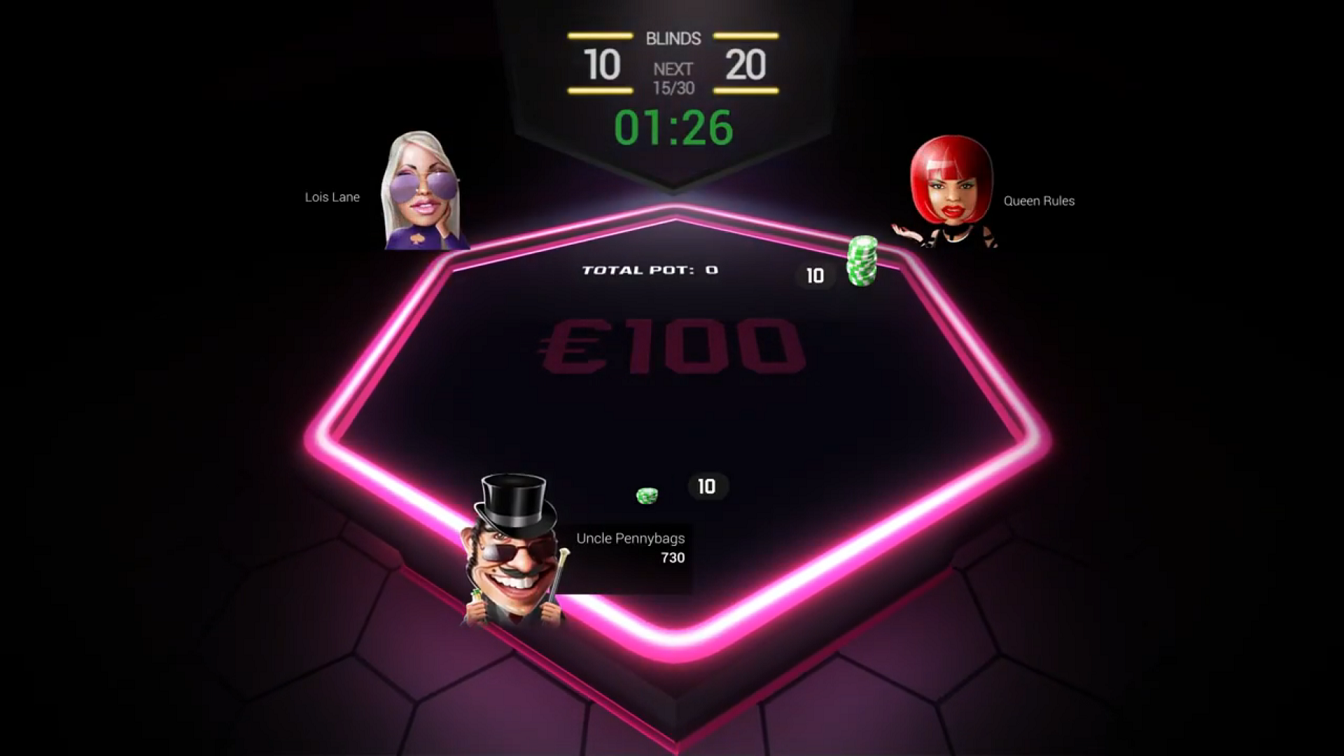
This brings me to Poker.com, where I have recently started playing sit and go tournaments. Some of the features on the site provide genuine extra value to players, and top of my list is the unique hand history information. The way this is presented to players is worth its weight in gold, allowing you to visualize past hands instead of the agonizing scroll through of text, at best - some online poker rooms are way behind when it comes to this kind of functionality. I think fondly of one large network, which shall remain nameless, where hitting the "history" button (or their equivalent button) freezes your current game, terminates the window, and disconnects you. Tremendous! Don't look back while you're still in a hand over there, must be the message.
Over the next few weeks I intend to chronicle some of my more interesting performances, win or lose, and usually it is the losses that provide more instruction and insight both for me and you, gentle reader. I make plenty of mistakes, but I'm also learning and improving at a rapid rate, and in poker that is the only thing that matters in the long run.
Marc Weinberg
More about online poker at Online Poker Insider
Posted at 2:20 AM Permalink | Talk on the Poker Forum


1 Comments:
Love your reasoning on tourneys and will be following your results. However, I don't agree with your assessment of ring table deception.
Yes, new players present a problem, but deception is possible, along with many subtle tells that enable a good player to quickly evaluate another player's style and to control the pace of his or her play.
In fact, I consider that talent absolutely necessary for online poker in any setting, but more so on tourney tables, especially on the lower buy-in tourneys where many of your readers play.
For example, last night I was on a ring table getting the best of it. There were two players using a mixture of styles that kept their plays hard to read. One player, however, folded way too much. Of course, when he bet, I folded everything except the nuts, as did most of the other players who had been sitting at the table long enough to read that behavior. The folder reloaded his stack twice during the session and never got off of his low buy-in stack (another tell: do you have enough confidence in your skills to risk the maximum buy-in or are you "protecting" your bank roll with the minimum?). Fold or raise with more frequency than you should, and any good player will use that information wisely, as demonstrated by the next player's example.
A walking bank showed up with open doors and an open mouth. You know the type. In fact, most folks have been verbally assulted by this type at least once. I instantly suspected he was the super aggressive player who believes unwarrented verbal abuse is some type of strategy. He was presenting huge implied odds to everyone on the table, without regard to any other style on the table. He pounded the felt with semibluffs and pure bluffs. The timid players folded the nuts of course when faced with the reraises. And, as usual, the better younger players started yakking back at the bank. I thought they were going to scare him away. One was asking him to leave. I posted this: "'player's name', I want him in" to the request for him to leave. The bank posted "lol" to my post, so I knew he couln't sustain the facade.
Then, my patience paid off: a big drawing hand landed in my lap--just as it would have to any other patient player. The chatter continued--of course, but I stayed out of it. They were yelling at each other (caps). I had been staying out of it--which is the only defense against verbal assaults, so I was sure he thought I was a chaser as I called his huge implied odds before and after the flop. But, I also knew he was busy spouting his mouth, just as many agressive online players do, failing to understand that what they say is a huge tell. If you come in cussing, I can tell you are under 25 and cannot have the experience that someone like "Grandpa4Times" has--a name that also tells me something about that player, specifically the possibility of a long history of poker. Coincidentally, Grandpa4Times was at the table, and he was quiet as well during the verbal assult. I was just hoping that I would catch the nuts before he did. By that name, I knew he would know how to fully open the vault door before I could get some of that free money.
By fourth street, I had the nuts (full house). I had already put him on two pair, and in fact, I suspected he was semi-bluffing with a face card and an undercard. I further suspected that he was a little more agressive than normal, so I put him on the top pair, which he had. I'm still learning to read players, but this type is doesn't take much thought.
He was first to act--just where I wanted him. As predicted, the super agressive player quickly threw out half of his stack (yes, the time taken to make a bet is a tell or a deception). At the same time, he was still arguing the superior play of his last drawout with another player.
I quickly raised, and as usual, the bank openned the entire vault, pushing his entire stack into the pot. I called of course, and he shut his mouth instantly, realizing he was caught by the only person who wanted him at the table. Was he on tilt? Possibly, but I was betting on that. His mouth and play gave away so much information that he was easily played.
After he left and all of the other players thanked me for busting him, I posted this:
"The next time a walking bank sits down and opens the doors, let him play."
Of course, the hand had negative expectation for me from then on. None of my large hands paid off until other new players arrived. I left the table soon after.
Sitting down at a ring table might not be your game style, but it is certainly as rich with deception, tells, and excitement as the tourney table. If fact, IMHO, the tourney present a much wilder setting with players being moved. Can't tell you how many times a table move has twarted my come back on a tourney table. With no input on personal choice of position on the table (i.e., timid to the left and agressive to the right), I find ring tables a welcomed respite from the feeding frenzy of agressive players trying to make their stacks in early tourney rounds. Again, patience pays off, and sometimes I open their vaults before they get away to another table or I'm moved right in front of the chip leader, who I haven't seen play.
If you think that there's little possibility of deception at online ring tables, even the low stakes tables, maybe you're already giving too much information away.
By
Anonymous, at 11:41 AM
Post a Comment
<< Home