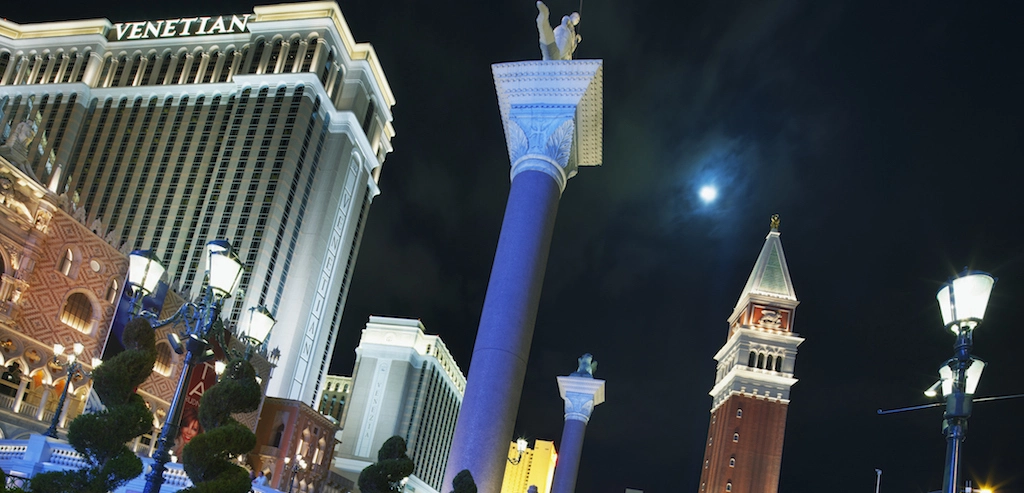
I have played no online poker for the past week, but before you begin to lose faith in my unquenchable desire to play poker whenever possible, let me explain: I went on a pilgrimage to Las Vegas, my Mecca, enjoying the hospitality of Poker.com when they hosted a magnificent party at the Venetian, and testing my abilities at the Bellagio’s poker room. On Tuesday I decided to enter the $500 + $40 no-limit hold’em tournament held by the Bellagio, even though that’s a big buy-in for me, and I happened to notice at least two grizzled veterans of the World Series Of Poker were competing against me. It wasn’t all that hard to notice because they were both at my table, and one, “Minneapolis” Jim Meehan, was fortunate enough to be seated to my left, enabling him to beat up on me at will. The other, Tomer Benvenisti, whom you might remember as the guy who came 5th in the Main Event at the WSOP in 2003, Moneymaker’s event, was across from me. There were 50 opponents in all, and many of them were faces you would recognize from high-limit tables that I can barely afford to watch never mind sit down at.
There was a surly poker pro from Norway, two girls who had played in numerous WSOP events a couple of months ago, and thankfully also a handful of rank amateurs who had never entered a poker tournament before and wanted to see what all the fuss was about. They lasted all of twenty minutes, and probably still have no idea what all the fuss is about. Jim Meehan, who won a bracelet for no-limit hold’em at the 2003 WSOP and who carves up poker pros for a living, schooled me for the first hour of the event, during which my main goal became one of survival. There were weak players at my table and the guys with world series bracelets were not them. I needed to focus on the poker virgins and avoid the players that were better than me - a key poker lesson in general, by the way.
I picked up a few ideal no-limit hands that all improved enough to bust opponents: 77 that made a full house on the turn, and 99 that turned into a beautiful nut-straight on the river to break an opponent who had slow-played QQ. He seemed to think that I had got very lucky to beat him. What he failed to comprehend was that he allowed me to get lucky, and that’s the far greater crime in poker. If he had re-raised me before the flop, on the flop, or on the turn I would have gladly yielded the pot to him as he had position. But he flat-called me three times, and the river spelled his doom, not to get too melodramatic or anything.
There were other players who made equally appalling mistakes. One insisted on showing his cards whenever he went all-in and failed to get any callers. It was always Ax, and he would accompany his generous gesture by saying that the only way to play AK or AQ is to go all-in because you don’t want to see flops with that kind of hand. I waited patiently for him for hours on end. Eventually, when there were four of us left and he raised all-in from the button I was happy to call him with 77. He showed A6, which was exactly what I hoped he had and that was the end of his event.

Before that gratifying moment I found myself the chip leader at the final table facing 9 dangerous opponents, and knowing that they only paid out the top 5 finishers. Jim was back at my table, several drinks spread around him, his chatter non-stop, loud, and frequently hilarious. The other players bristled at him, and were too stupid to realize that they were playing right into his hands. Meanwhile Tomer Benvenisti showed what a phenomenal player he is by doubling up twice when he was down to the felt. Suddenly he had a lot of chips again, and I considered these two poker champions to be huge dangers. At the same time I didn’t want to settle for a money-finish, even though this was a big no-limit tournament at the Bellagio and I could barely breathe every time I thought about it. I wanted to win, because I had played very well and put myself in position to win.
With a lot of chips in front of me and 45 of spades in the big blind I was faced with a tough decision when Tomer raised all-in from middle-position. Everyone folded to me. I could afford to see his bet because I would still have over 20,000 of the 100,000 chips in play if I lost. By this time we were 6-handed, which meant that if I eliminated him I would definitely be in the money. Furthermore, he’s a great player and you have to take your chances in no-limit to get rid of the players who are better than you, provided you have the chips to try. He turned over AT, which was about what I expected, but they were spades as well! My outs were minimal. Then the flop came: 4-K-J all hearts. I had made bottom pair and the 4s held up to knock him out. The atmosphere at the table was one of mutual respect and sheer professionalism. Funny how that is never the case when you play $4-$8 with the college kids who all think they’re trying out for a sequel to Rounders.
When we got down to three players we started to discuss the possibility of a deal. The money was very important to me, and the thought of splitting the pot three-ways for a very nice payday was far more pressing to me than the glory of winning the event. Both Jim and the other player, a very strong pro from California, agreed to a deal, but only after the button went around one more time. So, three more hands, which seemed fair as we all had roughly the same amount of chips in front of us, although Jim probably held a slight edge in terms of chips, and a huge edge in terms of overall ability.
The first hand of the three saw me in the big blind with K5 off-suit. Jim folded on the button and the California pro limped in. I checked. The flop came 5-5-7 with two clubs. He made a substantial bet at the pot. I thought about it for a while and eventually, reluctantly called. I was just waiting for him now. The turn brought a J of diamonds. Without hesitation he said he was all-in. I called and stood up quickly. He turned over A8 of clubs, and groaned when I showed him the 5. The river brought no club and he was out in 3rd place. Afterwards, when I went up to congratulate him, he was angry with himself for limping in, something he didn’t do throughout the event. He was right - a big bet pre-flop and I probably would have folded, because he had been so selectively aggressive before that. But once again he gave me room to play, and in no-limit poker that is often fatal.
We were now heads-up, and it occurred to me that I would prefer to do a deal with Jim rather than battle him for 1st place, especially since the prize money for first was double that for second. We agreed to a deal whereby my extra chips would be rewarded with extra cash, but he would be listed as the 1st place finisher in the event. I would much rather be paid 1st place prize money as opposed to being listed as the 1st place finisher. That’s because I am a new struggling pro whereas Jim has netted $300,000 in a single event’s work before and probably values the result slightly more than the cash. I guess I’m just a whore when it comes to these things.
The tournament was an enormous thrill for me because I proved to myself, and my long-suffering wife and family, that I can really compete at a very high level, and more than hold my own. Now, when I write strategy articles and dish out advice about playing poker I feel a little less fraudulent, and very slightly closer to becoming a poker expert. This is a game where you can never read enough, think enough, or push yourself enough, and the beauty of it all is that every day I play I find myself at a table where there are players whom I respect enough to stay away from, and any pursuit that both rewards you and keeps you humble like that has to be extraordinarily worthwhile.
Marc Weinberg
More about online poker at Online Poker Insider